
SMK Annual UK Campaigner and Changemaker Survey

Your voice matters: Help shape the future of campaigning
Now in its eleventh year, the SMK Annual UK Campaigner and Changemaker Survey takes the temperature of campaigning in the UK.
This survey is aimed at campaigners, changemakers, advocates and activists across the UK. Legendary campaigner, Sheila McKechnie, believed in the importance of people being able to shape their world. This is the founding principle of SMK today.
Why do we run the survey?
The survey has become one of the few annual snapshots of the realities facing campaigners across the UK. It helps us understand not just what issues people are working on, but how the wider environment for campaigning is changing.
Over the last decade, the survey has tracked significant shifts in the sector, from changes in public attitudes and political culture to the growing pressures facing campaigners and civil society organisations. The findings provide invaluable insight into trends that might otherwise go unseen.
At a time when campaigning is evolving rapidly, evidence like this matters.
The survey helps us answer important questions:
- What challenges are campaigners facing right now?
- Where are people finding success and momentum?
- What support does the sector need?
- How confident are campaigners about the future?
- What threats and opportunities are emerging?
By collecting these experiences year after year, we build a picture of the health of campaigning and civil society across the UK.
This year SMK is pleased to be working with the Quakers In Britain on some aspects of the survey analysis and storytelling. They hope to augment the research by carrying out a small number of follow up interviews, allowing them to delve into campaigners’ experiences in more detail. You will be asked if you would like to contribute to this when you fill in the survey so more reason to take part.
Insights from SMK’s Annual Campaigner and Changemaker survey 2025
Hope in Collaboration: How campaigners are responding in the toughest year yet.
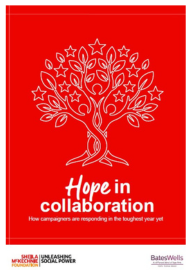
A snapshot from the 2025 survey results
Campaigners warned of the toughest year yet with rising threats but also a surge in hope-fuelled collaboration.
Data revealed that the UK’s campaigning environment deteriorated to its worst point in a decade with 69% of campaigners saying things have got worse in the past year. Yet despite unprecedented pressure, the survey results also uncovered a powerful counter trend: campaigners are deliberately cultivating hope, collaboration and community resilience as tools for social change.
Key findings included:
- 69% said the environment for campaigning has worsened, the highest level recorded since the survey began in 2016.
- 43% of campaigners felt personally threatened or exposed by their work, with risks increasingly “stacked” across online harassment, identity-based targeting, and far‑right intimidation.
- 21% cited a lack of belief that social change is possible as a major threat, a striking new trend.
- 100% believed campaigning by civil society is legitimate, and 98% said more campaigning will be needed in 2026.
- Over half experienced a breakthrough or success in 2025, often empowered by grassroots voices, collaboration, and long‑term relationship‑building.
- 93% wanted to collaborate more, but lack of time and money remain the biggest barriers.
What SMK’s Chief Executive said:
“Campaigners are facing pressures that would have been unimaginable a decade ago, from rising extremism to shrinking civic space and a deepening sense of public fatigue. Yet what stands out in this year’s findings is not despair, but determination. Campaigners are choosing to hope as a deliberate strategy, and they are building it together through collaboration, community and courage.”
Katie Roberts
Chief Executive, Sheila McKechnie Foundation
Previous surveys
2024 - 2025

- Optimism remains, but many campaigners taking ‘wait and see’ approach to new Government
- Campaigners report better access to decision-makers (51%),
- A greater openness to policy influence (53%), and more meaningful consultation (59%).
- These are positive steps forward, yet expectations have softened since last year. Before the election, 66% believed a Labour government would be more open to campaigners shaping policy – now, with six months of experience, that number has fallen to 53%.
- The biggest shift comes in expectations around public political debate. Last year, 46% of campaigners believed the new government would be more willing to engage in open public discussion. That has now dropped to 26%.
2023 - 2024

- Campaigners increasingly feel the pressure of their work in the face of challenges
from government, the media, donors, and their own organisations – a diverse set of
stakeholders with complex and competing needs. - This has led three-quarters of campaigners to question whether they have the energy
levels to keep going – despite a similar number reporting they have achieved wins or
reached milestones over the same period. - The three words most used by campaigners to describe campaigning are:
challenging, tiring, and rewarding. - Campaigners highlight the need for infrastructure bodies and employers to provide
support for mental health and wellbeing, building links and communities of practice
with other campaigners, as well as more conventional offerings. - 65% of campaigners say the overall landscape in the UK has made it harder to
campaign in the past year. - While there is some optimism that a new government would lead to better
relationships between decision-makers and civil society, there is little belief it would
result in the more punitive measures that affect campaigning being repealed.
Read full survey results here >
Read the report Under Pressure here >
2022 - 2023

- 94% of respondents felt there are threats to the freedom to organise, contribute to public debate, influence political decisions, or protest (otherwise called ‘civic space’)
- 72% of campaigners felt politicians’ attitudes towards campaigners had become more negative
- High profile attacks on the National Trust and RNLI by the media and politicians seemingly backfired as 27% of campaigners said it led to them being more willing to speak out.
Read full survey results here >
2021

- 96% of respondents felt there are threats, formal or informal, to the freedom to organise, speak out, or protest
- The Police Bill dominated concerns with 46% saying it will affect the way they campaign.
- 62% of campaigners said external attitudes to campaigning over the past three years had reduced the amount of campaigning they do.
Read full survey results here >
2020
- 90% of respondents felt there are threats to the freedom to organise, contribute to public debate, influence political decisions, or protest (otherwise called ‘civic space’)
- 98% of respondents felt there would be a greater need for campaigning in the next 12 months.
- The COVID-19 pandemic led to 54% saying their organisation now put a greater priority on campaigning work.
Read full survey results here >
2019
- 87% of respondents felt there were threats to the legitimacy of campaigning
- 45% of campaigners felt government attitudes had become more negative towards campaigning.
- 57% felt civil society wasn’t as confident and proud about its right to campaign as it should be.
Read full survey results here >
2018
- 66% said negative media coverage of civil society was threatening the legitimacy of campaigning
- 49% felt things had gotten worse for campaigners over the previous year.
- Closing civic space, Brexit, and negative public perceptions were amongst the top reasons cited for things getting harder for campaigners.
Read full survey results here >
2017
- 90% felt there were threats to the legitimacy of campaigning.
- 49% felt things had become worse for campaigning in the previous year, with 19% saying they had not.
- 87% of respondents were concerned that the Lobbying Act would restrict the right to campaign.
Read full survey results here >
2016

- Negative media coverage of the work of the VCSE sector - 65%
- Conditions of funding discouraging campaigning - 63%
- Senior managers and trustees being more cautious about campaigning - 53%
- Guidance from the Charity Commission of England and Wales - 52%
- Campaigning has become seen as too risky or something that VCSE organisations should not be involved in - 52%