
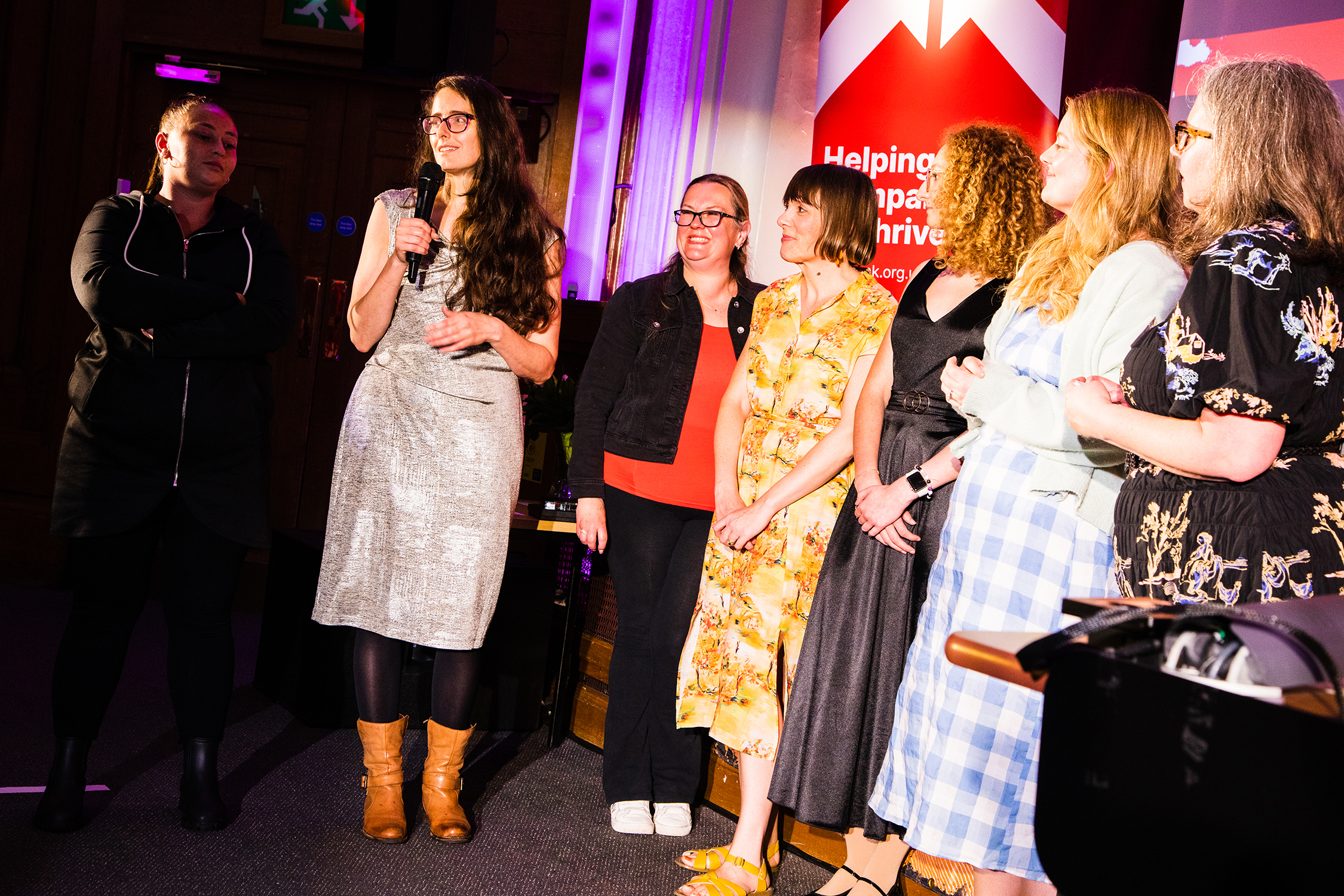
In this blog, Thea Jaffe, one of the parent campaigners for All Kids Count, reflects on winning this year’s Campaign of the Year Award.
A year ago, I stumbled in my high heeled boots from a corporate conference to a food bank.
What a contrast to two weeks ago: celebrating with fellow campaigners at the SMK National Campaigner Awards 2026, as the “All Kids Count” campaign to end the two-child limit on Universal Credit won Campaign of the Year.
The journey from that rock-bottom desperation that originally inspired me to join All Kids Count to standing in that room celebrating our success has been an epic one – not just for our coalition, but for the hundreds of thousands of children lifted from poverty by this movement.
I hadn’t planned on becoming a parent campaigner, and until last year I hadn’t even really clocked how much of my family’s struggle was due to the 2-child limit. I guess I was too busy surviving. My frantic juggle of single parenting three children while working full time meant constant calculation: walking instead of buses, relying on baby banks and second-hand items, and budgeting aggressively.
I’d thought I was just about managing – turns out, I was masking.
Things unravelled in March 2025 when a missing Universal Credit childcare payment of £1,500 triggered a spiral of debt and struggle. I thought maybe I wasn’t earning enough, so I put my salary into an income comparison calculator, expecting it to show me room for improvement. Imagine my shock when it showed I was already earning more than most other full-time workers.
If I was struggling that much on a “decent” salary, what about those families earning less than me?
I started looking up UK poverty statistics and learned to my horror that a solid third of children in the UK were growing up in poverty.
That’s when something clicked in my heart and I realised this was no longer just about me and my kids. This was about our children. All children.
Because who can learn that 4 million of our children are living in poverty and think, “Great, the system is working”?
The data was clear: the quickest, simplest way to make the most possible difference was to end the two-child limit, worth then around £300 per month for each impacted child. I had already been supporting the campaign, but over the next year I threw my whole self in, sharing my story with the support of coalition members including End Child Poverty, Single Parent Rights, Little Village, Save the Children, and Gingerbread. I started a petition, posted on social media, spoke to the press, joined projects and stunts and stayed up late writing op-eds. Alongside support came the backlash from trolls, influencers and commentators, but I was undaunted.
I could be this brave largely because of the strength of the campaign behind me.
Lived experience like mine made the campaign real and relatable for many people. But it could only have that impact because it was backed up by research and analysis. Without the bigger picture, stories like ours risked being dismissed as anecdotal. It’s much harder to dismiss my three children when they stand alongside hundreds of thousands more.
This campaign worked because it combined rigorous evidence, a clear, quick and achievable ask, a broad coalition and the persistence to keep going even when change felt impossible. For years before I even joined, campaigners patiently collected and analysed data, identified those affected, and documented impact so that when our moment came, the evidence was all there.
I remember sharing my story with one MP at a Westminster drop-in. He agreed child poverty needed action but said, “You need a new marketing strategy. We’re tired of hearing about the 2-child limit.”
That was the moment I knew our “marketing strategy” was working: the only way for Westminster to stop hearing about the policy would be to end it.
What continues to amaze me is that the end of the two-child limit isn’t the end of the story.
All Kids Count has helped change the way we talk about poverty. It challenged stereotypes around welfare by showing that most affected children were in working families. It reframed child poverty as a question of children’s rights and wellbeing, not of parental choices or worthiness. It highlighted the ways poverty intersects with women’s rights, disability, race, religion, family structure and single parent rights.
These conversations did not end with the policy change, but continue in charities, in Parliament, in the media, on social media and in everyday discussions about the kind of society we want to be.
The win was not only that the policy was changed, but how that change was framed: not just an economic necessity, but as a moral imperative to protect children’s rights, women’s rights, equality and dignity. Restoring these values to the center of policy design may prove to be one of this campaign’s most important legacies.
The campaign has also changed me. I continue to write about in-work poverty, the cost of living, debt, and hidden class assumptions, carrying with me the knowledge that sometimes, when we speak truth to power, power listens.
And while the additional money for my third child has so far been swallowed by childcare debt, it has also gone toward restoring a broader balance: the recognition that all kids count. Including mine.