
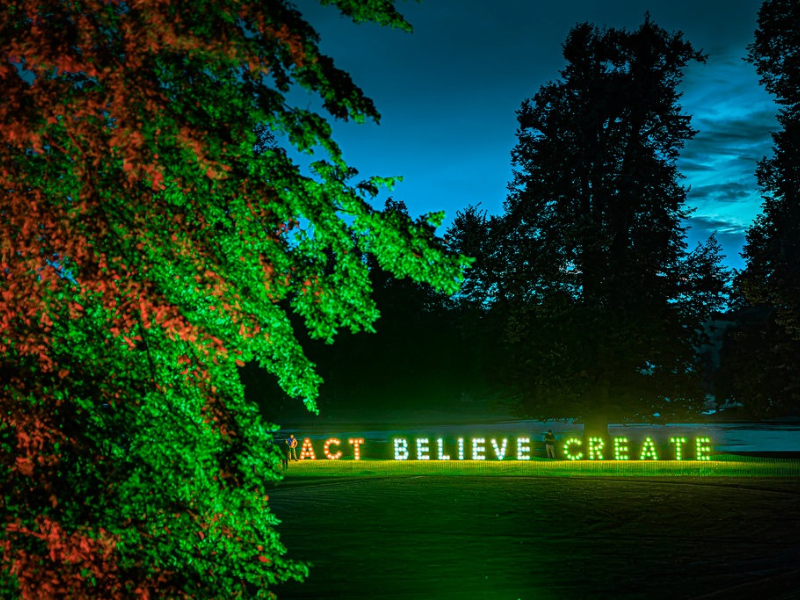
An interview with Paul Northup, the Creative Director of Greenbelt Festival, a space where artistry, activism, spirituality, and community all meet.
Greenbelt uses the phrase courageous activism. What does courage look like in the current UK social and political climate and how does Greenbelt help people recover their sense of agency?
From cancel-culture on the one hand to successive governments legislating against the right to protest on the other, the latitude for public dissent is being diminished. Amnesty International’s latest film The Fight to Be Heard is a powerful documentary evidencing this. Against this backdrop, Greenbelt continues to make a space in which collective action still feels possible and necessary. It does this by platforming those who continue to take action in the face of these chilling headwinds – supporting and celebrating them at the same time as inspiring those who hear their story.
After 50 years, what do you think Greenbelt has contributed to the UK’s social justice landscape? Are there particular moments or stories where you’ve seen the festival directly influence campaigns, organisations, or public conversations?
From the mid-80s, when we were conscientised to call and act for an end to South African Apartheid by mainstage DJs repeatedly inviting us to sing along to Free Nelson Mandela, to welcoming Palestinian artists, community leaders and peacemakers year-on-year; and from campaigning alongside Ann Pettifor and others at the turn of the millennium in support of the Jubilee 2000 ‘Drop the Debt’ drive to platforming artist-activists like Pussy Riot, challenging the oppressive and imperialist project of Putin, in more recent times; Greenbelt Festival has been one long invitation to be the change we want to see in the world.
Campaigners often talk about strategy and messaging, but Greenbelt shows that creativity can shift culture in deeper ways. How do you see art and activism working together to move people toward social or environmental justice?
We’re tired and suspicious of propositional truth. The managed prose of politics leaves us cold and often disillusioned. There is a sense in which this has always been the case. But it is perhaps even more so now. And that’s why artistry provides such a powerful alternative window into and way forward for encouraging people to decide and act for social and environmental justice. Poetry and artistry is prophetic in this sense, speaking from the margins rather than the centre, and troubling the status quo and disturbing the powerful. Art comes at truth obliquely, almost under the radar. And curiously, that makes its effect more powerful. It seeps into your soul where it can make lasting change. Acts of the imagination make a real world difference.
What have you observed about how community forms at Greenbelt — and how that community sustains people once they leave the festival?
When people feel they can be accepted for who they are, agency can be built. Greenbelt provides somewhere to believe in and somewhere to belong to. It is a space where people who have felt alone and discouraged in their everyday, year-round lives can find a welcome and solidarity, just for one weekend. And that is transformative. Realising you are not alone, but that instead you can belong to a like-minded community of people of good faith, is empowering. Although the festival only happens for three or so days each year, its effects are deep and long-lasting.
What gives you hope right now — in the arts, in activism, or in the communities that gather at Greenbelt?
The recent global fallout from Macklemore being cancelled from the Ed Sheeran tour and everything that has ensued has placed artistry and activism front and centre. It has sparked a mainstream conversation about the role of the artist. The question has become: why wouldn’t you be involved and speak out on justice issues as an artist?; rather than why would you? This, together with arts insurgencies like Brian Eno’s Hard Art collective, who have birthed The Fête of Britain and Absurd Intelligence in recent times – give me so much hope. Because they clearly show that, perhaps now more than ever, there is a real feeling that only art and the artist can help to drive the change we want and need to see in the world.
Want to hear more?
Greenbelt has generously shared it’s back catalogue of over 20 years of recorded talks from artists, activists and faith leaders, for free. So why not dig into this treasure trove to inspire your work? Whether you’d like to hear from the UK’s most arrested Priest, find out how to take on big oil and win from climate campaigner and lawyer Tessa Khan, to how to defeat the far right, from HOPE not hate’s Nick Lowles.